We live in a world of information — some useful, some not. The abundance of digital noise around us has become a familiar background, but it is important to understand: information and data are completely different things. There are terabytes of data around us, but necessary information is constantly in short supply. Exactly the kind that is needed at a specific moment to make an accurate, well-considered decision — whether in business, medicine, biology, or sociology.
In fact, data analytics has existed for a very long time. Ever since the concepts of reliability and probability appeared, the need for mathematically sound decisions arose as well. Today, the demand for "evidence-based" decisions (data-driven decisions) is only growing.
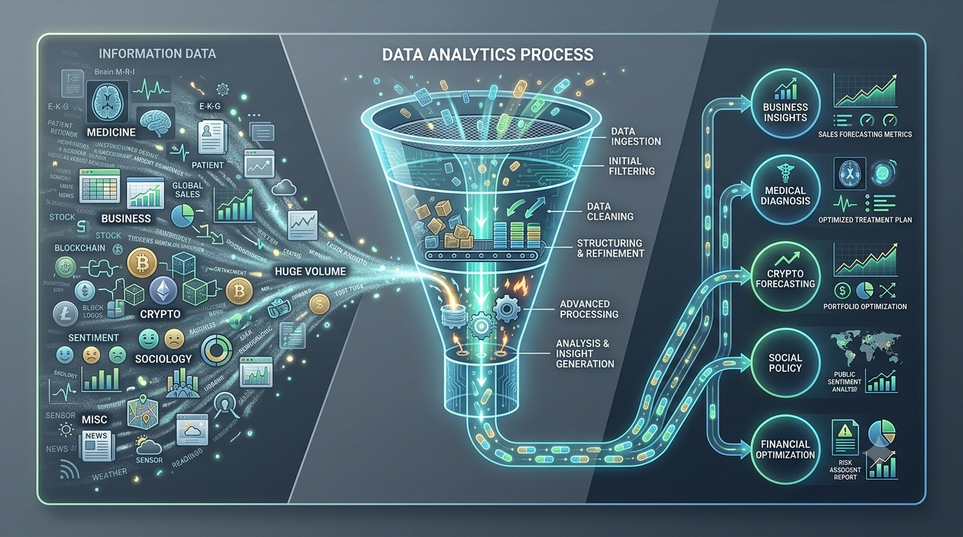
In every field, this demand has its own face:
Business sets pragmatic tasks: how will adding a single button to a website or changing its design affect the conversion rate of visitors and sales growth? Essentially, you need reliable feedback to consciously invest resources in marketing rather than acting at random.
Medicine — here, analytics is critically important because human health is at stake. For example, evaluating the safety and efficacy of a pharmaceutical drug before it enters the market is a huge responsibility. That is why medical analytics is a separate world with its own strict methodology of double-blind or placebo-controlled trials (placebo-controlled trials).
Biology also has its own challenges. Whether it is about colossal volumes of genetic data or analyzing the ecological niche of an endangered species, trying to understand these signals and make a forecast resembles a deep-sea dive: the depth increases, and the light decreases.
To help the analyst, new software packages appear every day, allowing part of the routine calculations to be transferred to the computer. The modern market for statistical software is huge. However, the search for a certain "magic button" that will automatically generate a detailed and correct report based on your data still requires deep professional knowledge.
Toolkit of modern analysis: for delicate and complex biomedical tasks and deep analysis, automated reporting systems are not enough. Flexible coding in R and Python in synergy with SQL databases comes to the fore.
Today, computing power has ceased to be the main limiting factor. What comes to the fore is not just the speed of calculations, but the qualitative interpretation of the results — the search for hidden insights (data insights). That is why the synergy and cooperation of an analyst with a subject-matter expert is so important.
The data study itself always resembles an exciting journey. Let's look at it step by step.
A Journey Into Data: Step by Step
1 Defining the goal
The main question to start with: where and why are you traveling? Without a clear understanding of the task or with a request "to make it look nice," it is the same as looking for a needle in a haystack.
2 Data collection and cleaning
At the stage when the goal and the end point of the route are known, the most interesting part begins: where to get the data and what kind is needed? For example, what needs to be tracked to evaluate the effectiveness of that very button on the website? When the data is collected, it needs to be prepared: cleaned (data cleaning), anomalies and error values found (outliers), missing values eliminated (missing values), the information brought to a single format, and made suitable for machine processing.
3 Exploratory data analysis (EDA)
At the next stage, it is important to generally understand what exactly you are dealing with. When you look at an endless table, streams of numbers appear before your eyes, a kind of "matrix." Visually evaluating a large array of data is not easy. This is exactly where exploratory data analysis begins. Its goal is to form a general idea of the data and understand what exactly is worth looking for next.
4 Pattern recognition and segmentation
When the primary fog clears, it is time to search for structure (pattern recognition). At this stage, the analyst looks for hidden connections, regularities, and groups the data. For example, when you need to not just look at the general mass of customers, but divide them into clear segments by similar behavior (customer segmentation) or identify how one metric is connected with another (correlation).
5 Forecasting (Predictive analytics)
And finally, the final point of the route. Past and current data allow us to look into the future. Based on the collected and structured information, the analyst builds models that predict the further behavior of indicators: how many goods will be sold next month or how demand will change under conditions of increasing competition. The journey ends with accurate guidelines for decision-making.
If at any of these stages you recognized your current task — from finding the necessary data to building a forecast — visit the Contacts page. Let's discuss your project and together turn data arrays into clear conclusions and useful decisions.